
Tokenized Risk Infrastructure · Delegated authority

One record for every programme, from bordereau to settlement.

MGAs report once to every carrier and know what they owe and are owed. Carriers take in each MGA's business, cede it through their treaties and track every amount, in one record they control.

How it works today

  1. Each carrier wants its bordereau in its own format, so the MGA rebuilds the same month's data once for every carrier.
  2. The carrier rekeys each MGA's file and rebuilds the book, then works out every cession and every reinsurer statement in spreadsheets.
  3. Every party keeps its own copy. At month-end, people match those copies line by line, by spreadsheet and email.

In Cork, each party records its own actions once. Everything that follows, from cessions to statements, comes from those same entries.

For MGAs

Report once to every carrier, know what you owe and are owed, and keep a signed record of everything you filed.

1 · Import

Your binders and bordereaux go in as they stand

Upload the wordings, schedules and endorsements of your binding authority agreements for all your carriers at once. Cork sorts them into binders and reads each term with the clause behind it, asking each open question once.

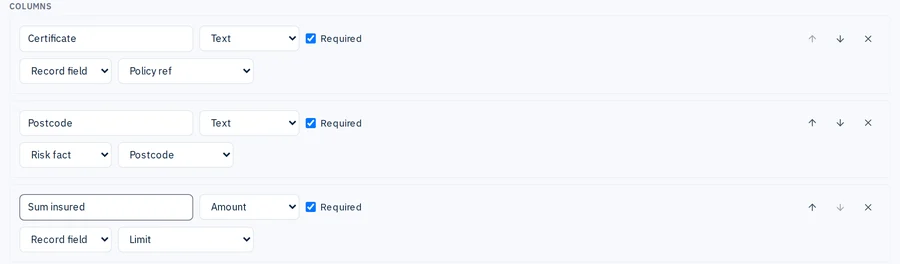
Your policy system's export goes in the same way. Cork suggests the column mapping, a saved mapping reads next month's file, and one file can carry business for several carriers: each row routes to its carrier.
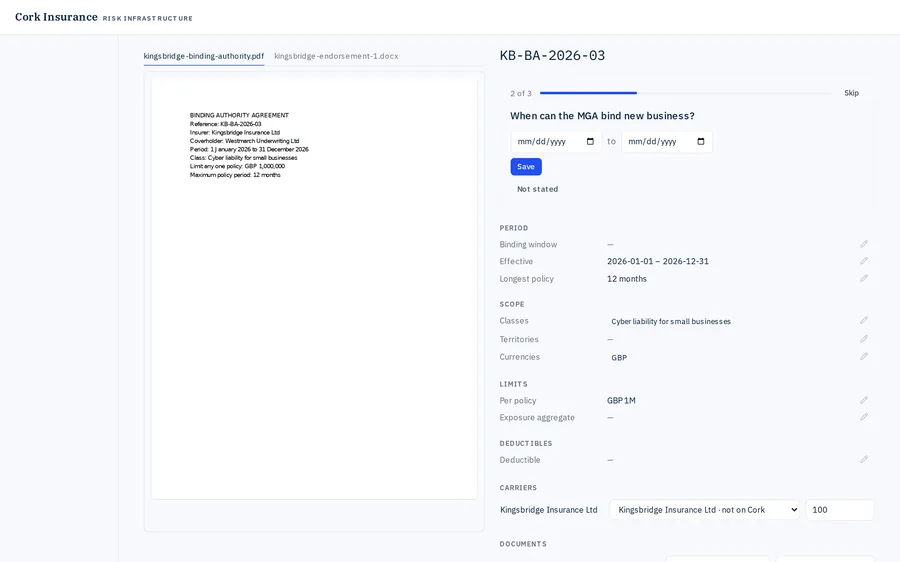
A binder's open question beside its wording

2 · Reconciliation

Reconciliation runs on every upload

Cork compares each new file with what you filed before and with the binder, before anything reaches your carrier. Each row lands in one of four states, and each fault names its table and row.

UnchangedHUA-WH-2026-0201 · Riverside Cold ChainNo action needed
ChangedHUA-2026-0002 · premium36,000 → 42,000
DuplicateHUA-WH-2026-0201 · sent againAlready recorded
RefusedRow 3 · HUA-WH-2026-0203Flood is outside binder NGM-WH-FIRE-2026
A filing refused in Cork, naming its file, row and reason

3 · Carrier reports

Each carrier's report, in that carrier's own format

Set up each carrier's format once, from its template, its instructions, an accepted example or the reporting terms in its binder. Cork lays out the tables and headings and proposes where each value comes from, citing its source. An example is checked cell by cell, and each version applies from the date you choose.

Each month, choose the format and the period. Cork shows the rows and totals before anything is issued, and lists what the carrier requires that your data lacks, such as a postcode or a peril code. You complete it once on the policy, and every format reads it. Reports issue as Excel, CSV or JSON with a reference and a revision, and your carrier accepts or queries that exact revision in Cork.

4 · Balances and record

Balances you can act on, and a signed record for audits

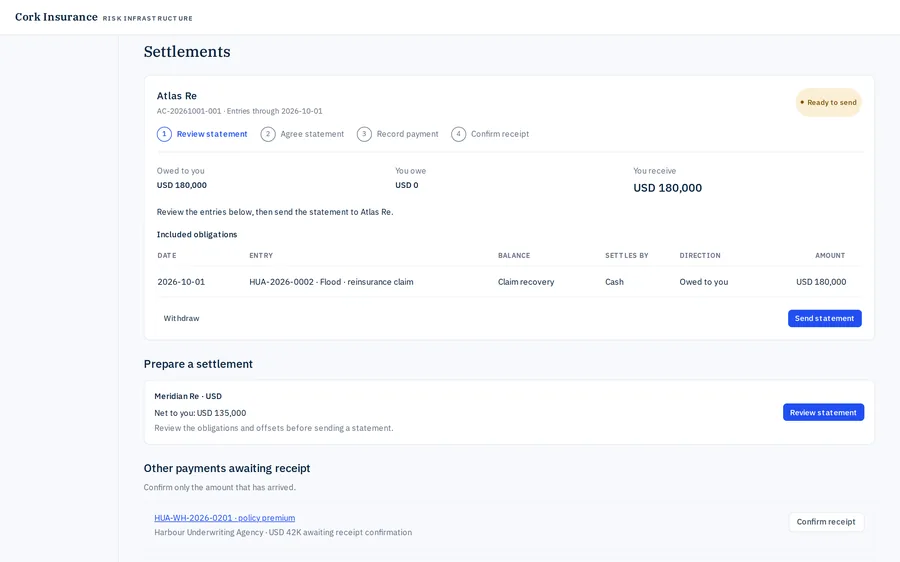
Premium and commission with each carrier sit as amounts owed, each tied to its policy and due date, with balances by age. You net them, report payments with a reference and prepare a statement for any cut-off date.

Each signed filing stays in a log with its items, source files and mapping, and any later change to an earlier filing shows. You can show what you filed and when, at audit and at renewal.

Balances with the carrier

For carriers

Take in each MGA's business, cede it through your treaties and track every amount owed, in one record you control.

1 · Intake

Each MGA row matched to its policy and its treaty

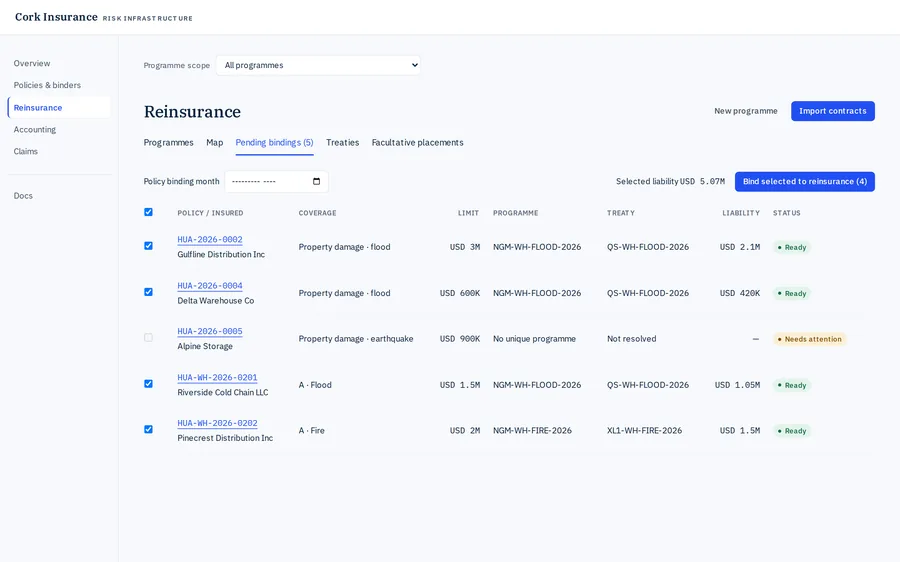
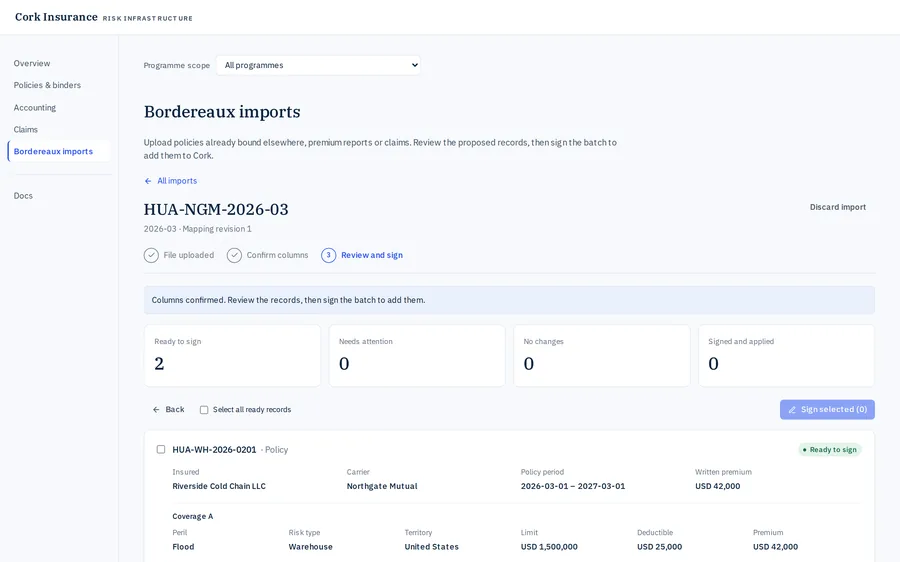
Each coverage an MGA files under one of your programmes must fit its binder, and the MGA's authority is checked per policy and in aggregate at every bind. Binders you agree to show each term beside its clause, and no change applies without your approval. For each policy, Cork shows the layers that match each coverage and any hold. Bind one policy or a batch of 200, and Cork cedes each coverage through the tower.

Pending bindings, each matched to a programme and treaty

2 · Treaties

Treaty terms read and tested for you

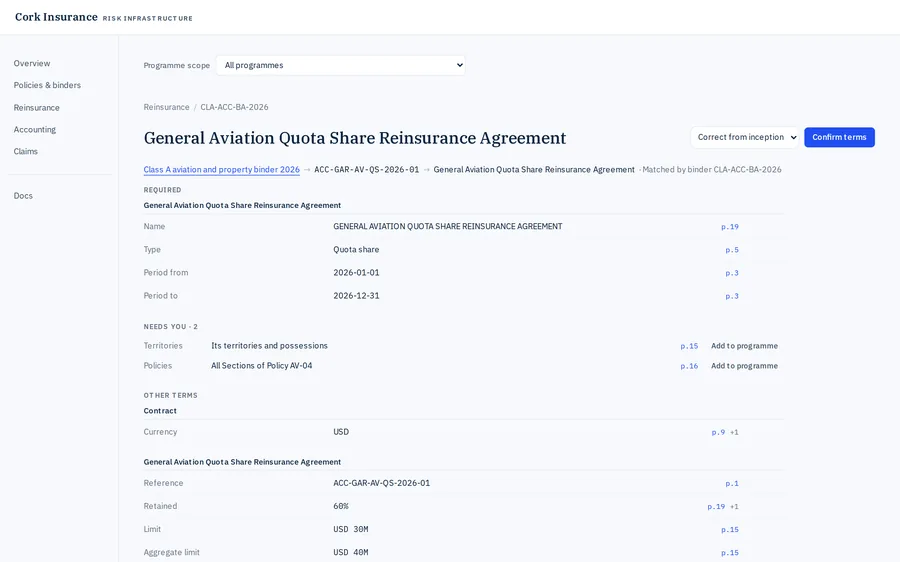
Drop the wording, slip and addenda under Reinsurance. Cork finds the programme they update and drafts the layer terms, each linked to the page and clause behind it. You back-test the terms against booked business and check a reinsurer's statement file row by row. After you confirm, Cork flags any booked figure that disagrees with a term.

Treaty terms, each with its page in the contract

3 · Exposure

Exposure in view

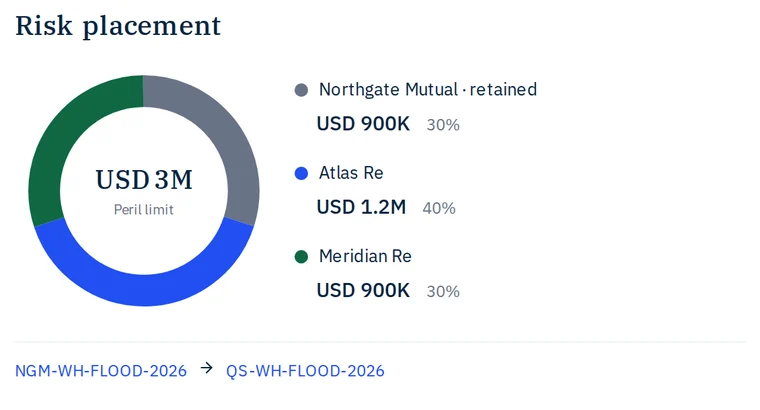
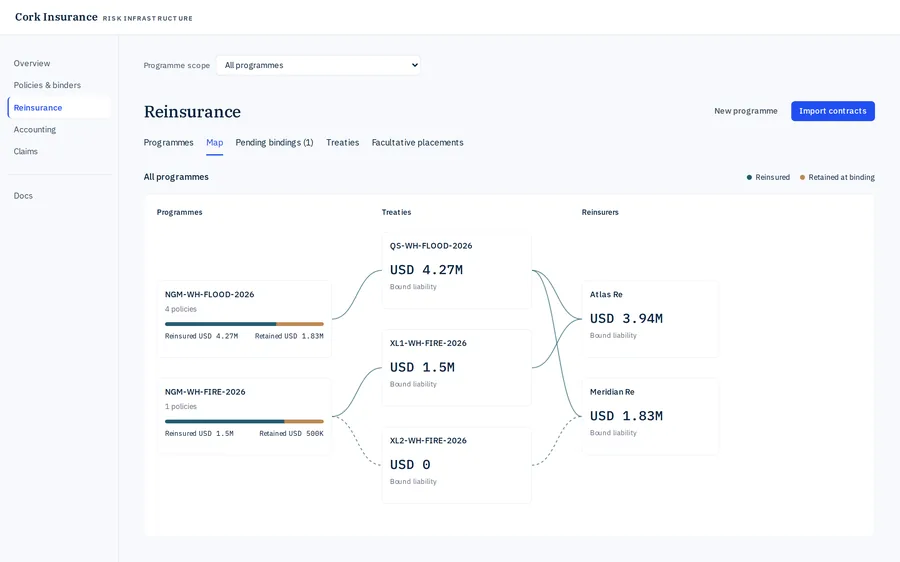
The map shows each programme, treaty and reinsurer with its bound liability. The Overview shows your retained limits, the reinsurance protection remaining, each programme's capacity and your limits by peril. Cork holds a reinsurance bind that would pass a programme or layer aggregate cap.

Programmes, treaties and reinsurers with bound liability

4 · Cash and reports

Cash tracked to its source

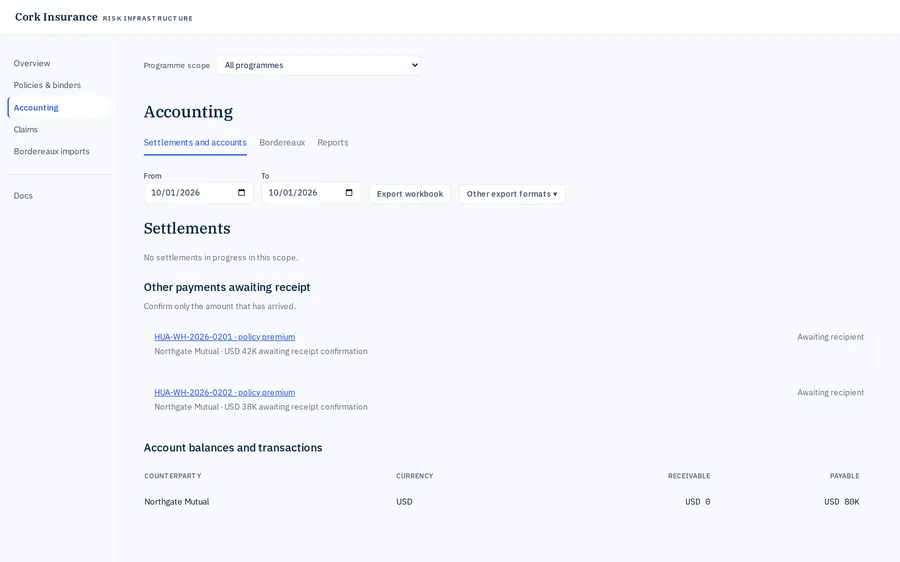
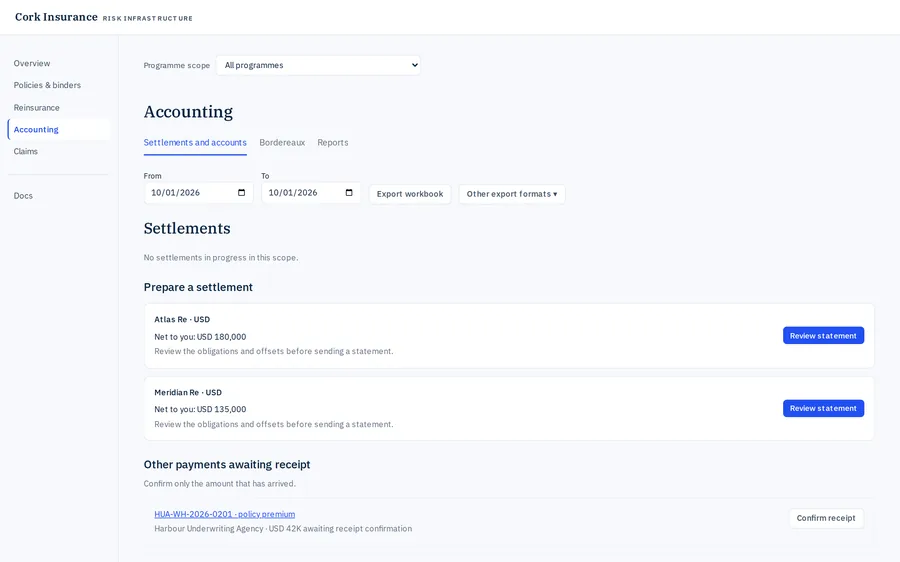
Premium from each MGA, ceded premium to each reinsurer and each recovery carry their source and due date, with balances by age. A recovery books on the day of settlement. You net ceded premium against recoveries and close each month on a statement. Period reports give your ceded business and retained position in each reinsurer's format.

Settlements and account balances

When counterparties join too

One reconciliation less for each relationship.

Each party sees only its own part of the programme ledger. When a counterparty also works in Cork, you both see each amount owed as it arises, and a statement that one side issues and the other signs closes the balance.

Reinsurers can check a carrier's cession reports against their own treaty, row by row, before the carrier joins. When it joins, its records are already in place.

MGAbinds USD 40,000 premium
Carriercedes 40% to the reinsurer
Reinsurer40% line
Ceded premium USD 16,000
Recovery USD 40,000
Statement nets to USD 24,000

AI integration

Your AI does the routine work, as your firm, in any MCP client.

Cork ships a standard MCP server. Your AI logs in as your firm, sees what your firm sees, and takes on the monthly bordereau, batch reinsurance binds, receipts, statements and the actions waiting on you.

  • Claude Code
  • Claude Desktop
  • OpenAI Codex
  • Cursor
  • VS Code
  • Any MCP client
Propose mode a person at your firm approves each shared changeExecute mode your AI submits it
Set up with one prompt
Install Cork and connect it to this AI tool as an MCP server. My Cork folder is <absolute path of the Cork folder>. Log in as my party in propose mode, register a local (stdio) MCP server named cork-insurance that runs node <Cork folder>/agent/bin/cork-ins-mcp.mjs, then call ins_whoami and tell me my party, role and mode, and how many actions wait on me.
Northgate Mutual · propose mode

Privacy and settlement

Each party keeps its own figures.

Cork writes a fingerprint of each amount owed to a shared onchain register, never the amount itself. Each party can prove its entries against it. Amounts can settle in a dollar-backed token, where the payment itself clears the amount, and collateral stands behind what each party owes.

Each figure entered once

By the party that owns it.

The MGA binds and files, the carrier binds the reinsurance, and the claims administrator records each settlement. Cork works out ceded premium, commission, reinstatement premium and recoveries from the terms, and every amount names the policy, layer, claim or amendment it comes from.

Get in touch

See Cork run on your own bordereaux, binders and treaties.